
The Context Engine: Why You Need a Second Brain
How a doom-scrolling habit accidentally became a productivity multiplier

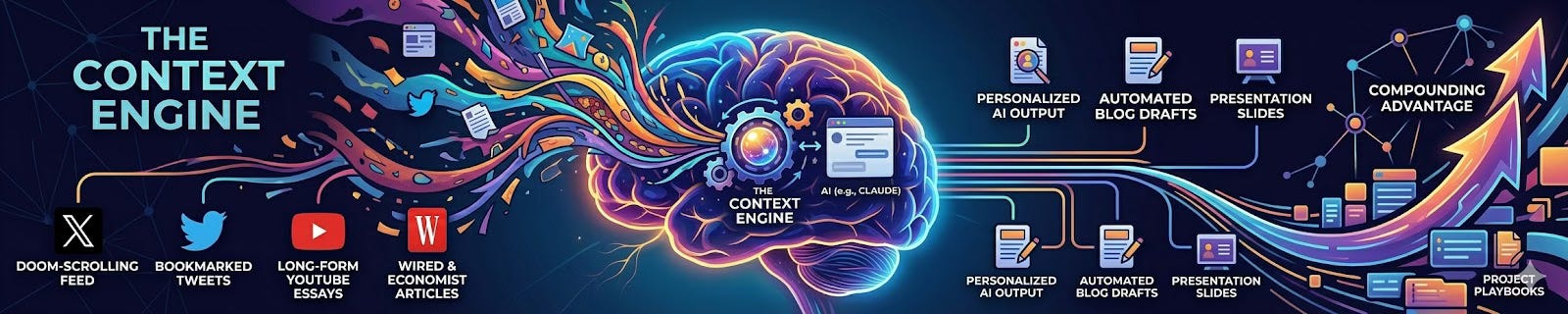
There’s a scene in The Hitchhiker’s Guide to the Galaxy where Arthur Dent learns that the answer to life, the universe, and everything is 42 — but nobody bothered to remember what the actual question was. We’re living that scene right now. More information than at any point in human history, flowing at us from every direction, and most of us are quietly losing track of what we actually wanted to do with it.
I’ll be honest: I’m part of the problem. I pick up my phone too often. Short-form content has genuinely eroded my attention span — I know this, I can feel it, and I’m mostly fine with the trade-off because amongst all the noise and divisive takes, I’ve spent years deliberately building a feed worth having. Substack essays, long-form YouTube, Wired, The Economist, researchers posting threads on X, practitioners sharing hard-won lessons on the tools and techniques reshaping how we work. A genuine stream of edutainment that keeps me sharp in a field moving faster than any individual can naturally absorb.
The problem isn’t the content. The problem is the loss rate. Something clicks, something sticks — then three weeks later I’m desperately searching YouTube history trying to remember a researcher who said something interesting about agent memory. I know I’ve seen this. I cannot find it. The information age equivalent of having the answer on the tip of your tongue, forever.
Research backs the feeling: the average knowledge worker spends roughly 2.5 hours a day searching for information they already have access to somewhere. According to McKinsey, employees burn 1.8 hours every day just gathering information — the equivalent of one in every five employees existing purely to search for things the rest of the team already know. That’s not an information problem. That’s a retrieval and context problem. And it’s about to get worse, not better.
The Second Brain That Didn’t Stick
This is where “second brain” comes in. You’ve probably heard the hype — Tiago Forte wrote a whole book about it. The idea is elegant: externalise your thinking into a system so you can think with it, not just about it. I bought in. Built it in Notion — meeting transcripts, notes, reference libraries, project trackers, client lists, a hierarchy of databases linked together with careful cross-referencing.
It lasted about four weeks.
The problem wasn’t the tool. Notion is genuinely wonderful. The problem was the system: it was over-engineered before I’d earned the habit. Maintaining it became a second job. Every captured thought required a decision. Which database? Which tag? which linked record? My brain, already context-switching at pace, quietly decided this wasn’t worth the friction. The system collapsed under the weight of its own taxonomy.
What survived was simpler. One database. Notes. Thoughts, meeting transcripts, blog drafts, half-formed ideas dictated while walking. No hierarchy. Just a timestamped record of what was in my head, tagged loosely and searchable. Not what the productivity influencers told me to build. But what actually stuck.
The Flywheel Kicks In
Gradually, over a few weeks of using it alongside AI, I started pointing Claude at it. Asking it to surface something I’d written months ago. Asking it to take a half-baked note and interrogate it until it became a post. Asking it to cross-reference a client conversation with something I’d read about governance frameworks. The notes database wasn’t just a filing cabinet any more. It was context. And context is what separates generic AI output from something that sounds like you, thinks like you, and actually serves the problem you’re trying to solve.
This is the context flywheel. The more you put in, the more usefully AI can act on it. Your opinions, your reasoning, your frameworks, your prior work, your instincts - codified and retrievable. Not a second brain in the Forte sense. More like mise en place: getting your ingredients prepped and organised before you start cooking, so when you need to move fast, you can move fast.
The habit that makes it work is micro-blogging — not for a public audience, but for context. Think of it as a Shakespearean soliloquy: you’re not performing for the stalls, you’re thinking aloud for the one audience that actually benefits from knowing your internal monologue. Your AI. A thirty-second voice note about why you disagree with a client’s architectural choice. A quick iPhone note capturing an idea that crystallised on a walk. A rough dictation on a project you’re wrestling with. These aren’t just reminders. They’re context deposits. The more your AI knows about how you think, what you’ve tried, what you believe, the less you have to explain from scratch every time — and the more it can act with your instincts, not just your instructions.
From there, Claude skills handle the production side. I have a blog writing workflow — a composable set of reusable instructions — that plays 20 Questions on a rough draft, challenges the logic, surfaces gaps in my argument, then structures a post from the rubble. (This post, as it happens, was written that way.) I have a presentation skill that produces slide decks against a company template. A proposal writer. An elicitation engine that asks me the questions I forgot to ask myself. These aren’t prompts. They’re capabilities built once and invoked whenever the situation calls for them.
Cowork closes the loop attending to multiple tasks in parallel. Creating the 4 ppts from the blogs i wrote yesterday. Creating a playbook from a weeks worth of meeting notes, work on diagrams in lucid chart, downloaded pdfs uploaded to claude projects, last weeks conversation history with claude and years worth of thoughts, findings and inspiration I’ve stored in Notion.
I’m planning on extending this. The plumbing will be elegant if not glamorous. IFTTT will handle the capture layer. If I like a thread on X, it can be automatically saved to a Notion note. Same with Substack posts I’ve bookmarked, news articles I’ve shared, reminders I’ve dictated into my phone. The iPhone note I scribbled this post into this morning can flow into Notion automatically. I’m don’t intend to manually file anything. The system will absorb what I pay attention to and store it somewhere I can find it again. I can then schedule CoWork to scan my Notion tasks overnight, surface what needs attention and propose a plan, sending it to IFTT event triggers that forward me a morning briefing, perhaps via Telegram, for review. I approve or redirect, and the cycle continues. All of this without writing a single line of code.
This Isn’t a Coding Problem
This is the bit people miss when AI conversations slide, as they always do, toward software engineering.
Think about what separates competitive Formula 1 teams from midfield runners and it isn’t usually the driver. It’s the information architecture: telemetry feeding engineers who feed strategy who feed the pit crew who execute a 2.3-second stop within a tenth of a second. Unless you’re Ferrari, in which case generically respond “We are looking” and you’re done (Sorry Ferrari fans).
It’s the marginal gains philosophy, compounding dozens of small optimisations through better systems and better data. You should apply the same principle to knowledge work. The Moneyball insight works the same way: the Oakland Athletics didn’t win with better players, they won because Billy Beane built a better information system than every other team in the league.
Context engines are the same thesis applied to knowledge work. The edge isn’t processing power or even model quality. It’s organised intelligence and the discipline to keep feeding it.
Which brings me to the uncomfortable part.
We’re currently somewhere in what I’d call the “AI-empowered” phase: individuals and teams using AI tools to get more out of the same hours. The next phase, call it harness engineering, is where the real productivity step-change happens. That’s where you stop using AI as a clever assistant and start designing orchestration layers: sequences of skills, sub-agents, MCP servers, context engines and event triggers that work together with minimal human intervention at each step. The industry framing for this is broadly “agentic AI”, and 2025 was the year it moved from concept to cautious enterprise experiment.
Agentic engineering, the craft of designing these orchestration layers, isn’t a baseline skill yet. Most organisations are still in the empowered phase, and that’s fine. But the direction is clear. The WEF’s Future of Jobs Report 2025 estimates nearly 39% of current skill sets will be overhauled or obsolete by 2030. McKinsey frames it similarly: prompt engineering and context specialisation are already emerging as organisational capabilities, not just individual party tricks. The trajectory points toward a world where the ability to design, sequence, and contextualise AI workflows becomes as foundational as Excel literacy was in 1995.
We’re not there yet. But the organisations and individuals who build these instincts now will have a compounding advantage over those who wait for it to become obvious. That’s how most technological transitions work - early adopters look eccentric until they look inevitable.
And the piece most people still get wrong? You don’t need to write code to participate in this. The skills required are different — prompt engineering, context curation, agent/skill sequencing, selecting the right tools and integrations, progressive disclosure techniques. These are craft skills. Learnable by anyone willing to invest the time. Not the exclusive domain of software engineers.
The Enterprise Version of the Same Problem
Everything described above at the personal level applies directly at the organisational level and the stakes are higher.
The context flywheel scales. A companies private skills/plugin marketplace, essentially a composable set of capabilities organised by craft or domain, is the enterprise equivalent of personal Claude skills. A corporate information architecture, structured around capability maps rather than org charts, becomes the context engine for an entire team. At Versent, the consultancy I work for, we’ve been building exactly this: an AI-powered information architecture with Notion as the backbone, combined with shared skills that any team member can invoke.
The capability map framing matters here. Before you design agents, skills, or automation, you need a view of what your organisation actually does - the departments, the capabilities they offer, the information that flows between them. That view becomes the architectural blueprint for your AI systems. Without it, you end up with the enterprise equivalent of my over-engineered second brain: technically impressive, practically abandoned.
The compounding loop is PDAC — Plan, Delegate, Assess, Codify. Define the work, crafting tasks, rationale, output expectations, agent skills, context and integrations. Hand it to an agent. Evaluate the output, refining the AI’s draft. Lock what works into a repeatable skills, content in Notion, etc. Repeat. Each iteration sharpens both the skill and the context it draws from. The system gets better because you feed it, and it feeds back into everything downstream - articles, proposals, playbooks, client deliverables, presentations.
The organisations that build this compound on their own speed and quality over time. The ones that don’t fall behind on AI adoption and they fall behind on the organisational muscle required to use it well. That gap is hard to close in a hurry.
The ones that wait will plateau. And they’ll blame the AI.
Working With Machines is about agentic systems, the future of work, and the gap between AI hype and what’s actually useful. If this one landed, subscribe.